How to Select the Right Stainless Steel Sculpture for a Modern Garden?
Selecting the right stainless steel sculpture for a modern garden is a decision that balances aesthetic vision, material science, site conditions, and long-term durability. Unlike traditional stone or bronze, stainless steel brings a distinctly contemporary energy to outdoor spaces — its mirror-like reflectivity, geometric precision, and weather-resistant properties make it the defining material of 21st-century luxury landscape design. This guide covers every dimension of the selection process, from steel grades and surface finishes to scale, placement, and care.

Why Stainless Steel Is the Premier Material for Modern Garden Sculpture
Stainless steel has displaced bronze and stone as the material of choice for contemporary landscape architects and luxury garden designers for three primary reasons: its dynamic interaction with light, its exceptional outdoor longevity, and its uncompromising modern aesthetic.
Reflectivity and Light Interaction
No other sculptural material engages with its environment as dynamically as polished stainless steel. A mirror-finished piece transforms throughout the day — reflecting the dawn sky at sunrise, the garden’s color palette at midday, and warm amber tones at dusk. It effectively becomes a constantly changing artwork, integrating the garden’s own landscape into the sculpture itself. This quality is why stainless steel has become the dominant medium for large-scale public art installations and landmark corporate headquarters worldwide.
Unmatched Outdoor Durability
Properly specified stainless steel is one of the most weather-resistant materials available for outdoor art. Unlike bronze, which develops patina and can degrade structural integrity without maintenance, or stone, which can absorb water and crack under freeze-thaw cycles, stainless steel maintains its structural integrity and surface quality for decades without protective coatings. Grade 316 stainless steel — the marine-grade standard used in environments within 5 miles of coastal salt air — offers corrosion resistance that substantially exceeds most competing materials.
Design Versatility
Stainless steel can be formed into virtually any shape: flowing organic curves, strict geometric forms, kinetic wind-responsive structures, or intricate laser-cut openwork panels. It can be finished in near-infinite ways, from mirror brilliance to matte brushed textures or custom colors. This versatility makes it equally at home in a minimalist courtyard, a grand estate garden, a corporate campus, or a coastal cliff-top terrace.
Stainless Steel Grades: 304 vs. 316 vs. 201 — Which Do You Need?
The single most important technical decision when selecting a stainless steel garden sculpture is the steel grade. Getting this wrong can result in surface rust, structural weakness, or premature deterioration — regardless of the artistic quality of the piece.
| Grade | Composition | Best For | Avoid If |
|---|---|---|---|
| Grade 201 | Low nickel, manganese substitute | Indoor display only; budget decorative use | Any permanent outdoor installation |
| Grade 304 | 18% chromium, 8% nickel | Inland residential gardens, urban environments, moderate climates | Within 5 miles of coastal salt air or poolside |
| Grade 316/316L | 18% chromium, 10% nickel, 2–3% molybdenum | Coastal gardens, poolside installations, high-humidity or industrial environments | — (recommended universally for premium outdoor use) |
“For a long-term garden investment, always specify Grade 316, even for inland sites. The modest additional cost over Grade 304 is insignificant compared to the sculpture’s total value and lifecycle.”
Surface Finishes: Mirror, Brushed, or Colored?

The surface finish of a stainless steel sculpture fundamentally changes its character, its maintenance requirements, and how it interacts with your specific garden environment.
Mirror Polished (No. 8 / No. 6 Polish)
The most dramatic option. Mirror polishing brings the steel to a reflectivity level that approaches a true mirror surface. In a garden setting this creates extraordinary visual effects — the sculpture appears to dissolve into its surroundings, reflecting the sky, foliage, and seasonal color changes. This finish communicates maximum luxury and visual impact.
- Best for: Grand statement pieces, large-format focal points, open garden spaces with visual sky access
- Maintenance: Requires regular cleaning (soft microfiber cloth, neutral cleaner) to remove fingerprints, water spots, and airborne dust. Plan for cleaning every 4–8 weeks in residential settings.
- Lifespan of polish: Indefinite with proper care; professional re-polishing available if scratched
Brushed / Satin (No. 4 Finish)
The most popular finish for private residential gardens. A directional satin texture is applied to the steel surface, creating a warm, matte sheen rather than full reflectivity. Brushed stainless reads as sophisticated and restrained — an ideal match for minimalist, Japanese, or transitional garden styles.
- Best for: Intimate garden spaces, contemporary residential landscapes, settings where low maintenance is prioritized
- Maintenance: Significantly more forgiving than mirror polish; fingerprints and minor scratches are largely invisible against the textured grain. Clean with grain direction using a soft cloth.
- Visual character: Warm silver tone; does not “shout” from a distance; suits naturalistic planting settings well
Electroplated / Custom Color Finishes
Stainless steel sculptures can receive electroplated coatings (gold, rose gold, black titanium) or professional-grade powder coating in virtually any color. These finishes add a layer of personalization and can dramatically shift the sculpture’s presence in the landscape — a matte black piece against white gravel, or a champagne gold form against deep green hedging, creates a very different visual statement than natural stainless.
- Best for: Bold design-forward landscapes, branded installations, when a specific color palette must be matched
- Consideration: Plating and painted finishes require more careful maintenance to avoid chipping; specify professional-grade industrial coatings with UV stabilizers for outdoor longevity
The 5 Main Styles of Stainless Steel Garden Sculpture
Before selecting a piece, it helps to understand the five primary design categories that define the stainless steel garden sculpture market:
1. Abstract Geometric
Clean angles, planes, spheres, cones, and cubes — or combinations thereof. Abstract geometric sculpture is the purest expression of modern garden design principles. It creates a powerful visual statement without figurative narrative, letting form, proportion, and material do all the work. Ideal for minimalist or architectural gardens.
2. Abstract Organic / Fluid Form
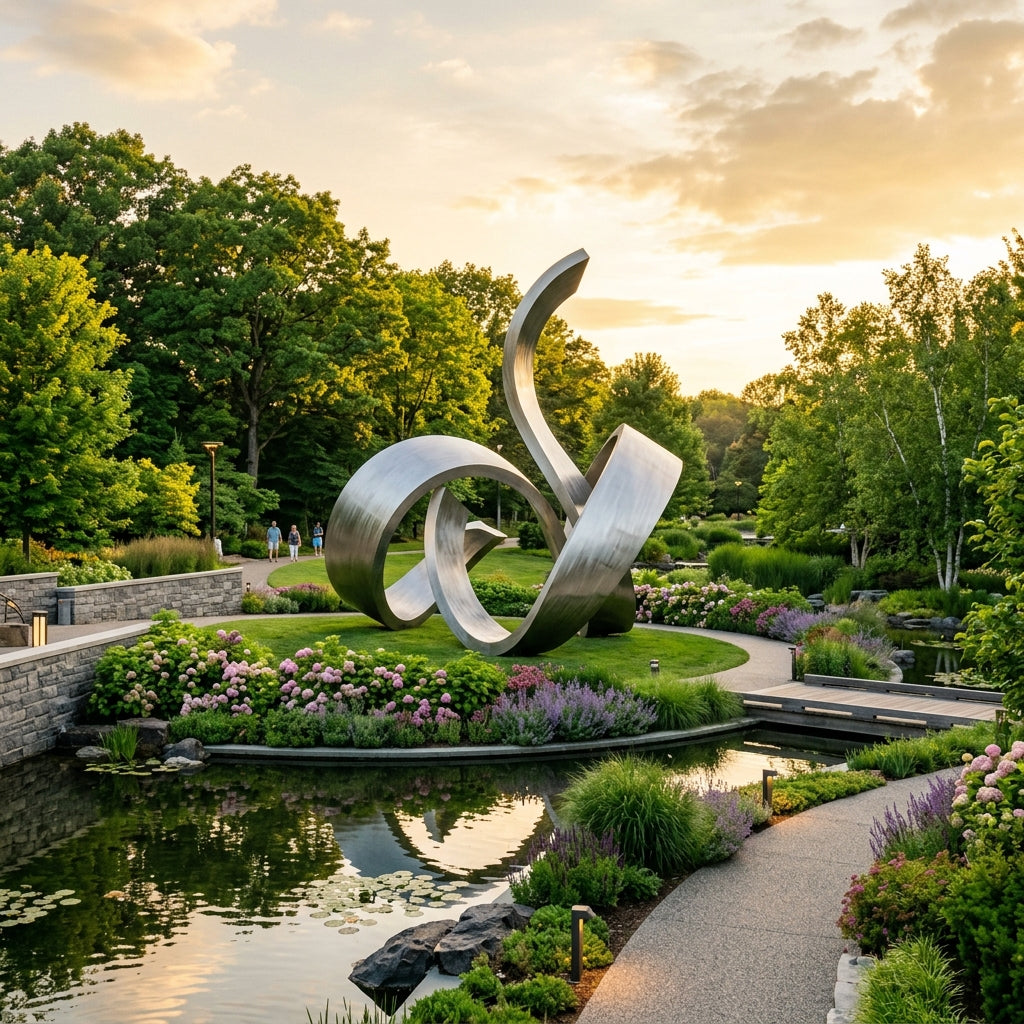
Flowing curves, biomorphic shapes, and forms that echo natural movement (wind, water, plant growth). These pieces bridge the gap between modern materials and organic garden settings, making them highly versatile. A fluid stainless steel form placed among naturalistic planting feels both contemporary and harmonious.
3. Figurative Stainless
Human figures, animals, or botanical forms interpreted in stainless steel. The contrast between realistic subject matter and the industrial material creates a compelling tension. Figurative stainless sculptures are popular for estate gardens where a strong narrative or symbolic presence is desired — a rearing horse, an arching human figure, or stylized botanical forms.
4. Kinetic Sculpture
Works designed to move in the wind, creating constantly evolving visual compositions. Kinetic stainless sculptures introduce an element of time and motion that static pieces cannot achieve. From large wind-driven spinners to delicately balanced mobiles, kinetic work animates the garden in a way that changes with every breeze. Best positioned in open sites with reliable air movement.
5. Functional Art — Sculpture with Integrated Features
Stainless steel sculptures that incorporate water features, LED lighting, fire elements, or even seating. These multi-functional pieces justify their scale and cost by contributing directly to the garden’s usability and atmosphere. A polished stainless water wall sculpture, for example, serves simultaneously as a sound screen, visual focal point, and atmospheric water feature.
Scale and Placement: The Most Critical Decisions
Sizing Your Sculpture to Your Space
Scale is the variable that most commonly determines whether a sculpture succeeds or fails in a garden setting. The rules are intuitive but worth stating clearly:
- Tabletop and entry accents (under 24 inches): For restricted spaces — balconies, small courtyards, raised planting beds. These pieces add refinement without dominating. Work best in multiples or as part of a designed vignette.
- Mid-scale pieces (2–4 feet): The most versatile range. Suitable for most residential gardens as standalone focal points or border accents. Can be viewed comfortably at conversational distance.
- Statement sculptures (4–7 feet): The luxury residential sweet spot. Large enough to command attention across a garden, create strong sightlines, and work as genuine architectural features. Require proper installation with concrete footings.
- Monumental scale (over 7 feet): For estate gardens, commercial landscapes, or public installations. Structural engineering is required. These pieces become landmarks that define the entire garden’s identity.
Strategic Placement Principles
Where you place a sculpture determines as much of its impact as the piece itself. Professional landscape architects use several time-tested placement strategies:
- Terminal focal points: Position pieces at the end of pathways, garden axes, or sightlines from key viewing positions (a kitchen window, a terrace seating area, a main entry door). The sculpture becomes the destination that draws the eye through the space.
- Rule of thirds, not dead center: Centering a sculpture in a lawn tends to feel static and institutional. Off-center placement at rule-of-thirds positions creates dynamic tension and a more natural, composed feel.
- From inside the house: Always stand at your main living room window, kitchen window, and primary terrace and assess the view. The best placement serves both garden visitors and those viewing from inside.
- Light throughout the day: Mirror-polished stainless steel in particular should be positioned to catch direct light. Consider how sunlight will track across the sculpture through morning, afternoon, and evening, and plan accordingly. Evening uplighting with LED spotlights significantly extends the sculpture’s visual presence.
- Wind exposure: Large flat-surface sculptures act as sails in high winds. For exposed garden positions, choose curved, hollow, or perforated forms that allow airflow through the piece, and ensure structural installation (concrete foundation, anchor bolts) can manage your local wind load specification.
Installation Requirements
Proper installation is not optional for garden sculptures above tabletop scale — it is a safety requirement. Key installation considerations:
- Concrete footings: Sculptures 3 feet and taller in exposed garden positions should be anchored to poured concrete footings with embedded anchor bolts or threaded rods. The footing depth and diameter depends on the sculpture’s height, weight, and wind exposure class — consult a structural engineer for pieces over 5 feet in high-wind zones.
- Drainage: The base area around the sculpture should be well-drained. Standing water around the anchor point can accelerate corrosion at the ground contact zone even with Grade 316 steel.
- Isolation from dissimilar metals: If mounting stainless steel to iron, aluminum, or other metals, use appropriate isolation materials (nylon washers, PTFE tape) to prevent galvanic corrosion at contact points.
- Professional installation: For statement and monumental-scale pieces, professional installation by an experienced art handling or landscape construction team is strongly recommended. Improper lifting or positioning can permanently damage polished surfaces.
Care and Maintenance Guide
Stainless steel garden sculpture requires minimal but consistent maintenance to preserve its appearance and structural integrity over decades.
Routine Cleaning
- Wipe down with a clean, soft microfiber cloth and warm water monthly (or after rain in dusty environments)
- For stubborn grime, use a small amount of pH-neutral dish soap; rinse thoroughly with clean water
- Always wipe in the direction of the grain on brushed finishes; use circular motions only on mirror-polished surfaces
- Never use: steel wool, abrasive scouring pads, chlorine bleach, muriatic acid, or any cleaner containing chlorides — these can permanently damage the passive oxide layer that gives stainless steel its corrosion resistance
Coastal and Poolside Locations
- Rinse the sculpture with fresh water at least every two weeks to remove salt spray and chlorine deposits
- Apply a dedicated stainless steel protective wax or nano-coating sealant every 6 months
- Inspect welds and anchor points annually for any early signs of crevice corrosion
Annual Maintenance
- Apply a professional-grade stainless steel polish (carnauba wax or dedicated metal polish) to restore mirror finish and add a protective barrier
- Check anchor bolts, structural joints, and any moving parts (kinetic sculptures) for tightness and wear
- Remove bird droppings immediately — the acidity of organic deposits can begin etching even well-specified stainless steel given enough time
Frequently Asked Questions
Will stainless steel sculpture rust outdoors?
Properly specified stainless steel — Grade 304 for inland sites, Grade 316 for coastal environments — does not rust in normal outdoor conditions. However, Grade 201 (a lower-quality substitute sometimes used to reduce costs) can show surface rust within months outdoors. Always confirm the steel grade specification with your supplier before purchasing. If you see unexplained reddish-brown staining appearing, it is typically “rouging” from external contamination (iron particles from nearby construction, for example) rather than corrosion of the stainless steel itself, and can usually be removed with a passivation treatment.
Which finish is easiest to maintain for a garden?
Brushed satin (No. 4 finish) is the lowest-maintenance choice for residential garden sculpture. Its directional grain texture effectively conceals minor fingerprints, dust, and light scratches that would be immediately visible on a mirror-polished surface. Mirror polish delivers the highest visual impact but requires more frequent and careful cleaning — every 4–8 weeks in a typical residential garden setting. If you want mirror polish aesthetics with reduced maintenance burden, look for pieces that use a combination of mirror and brushed elements: polished focal surfaces with brushed secondary areas.
How large should a garden sculpture be?
The general rule is that outdoor sculptures should be larger than your instinct suggests. Objects placed in open outdoor space tend to appear smaller than they would indoors due to the scale of sky and landscape surrounding them. A piece that feels significant in a gallery or showroom may disappear in a large garden. For a specimen lawn or main garden axis, pieces in the 4–6 foot range are typically needed to create genuine visual impact. Always request a scaled visualization (photo composite or 3D render) before committing to a size, or use temporary cardboard stand-ins to test scale on site.
Can stainless steel sculpture be installed near a swimming pool?
Yes, but Grade 316L is mandatory for poolside environments. Pool water uses chlorine disinfectants that are highly corrosive to lower-grade stainless steel. Grade 316L contains molybdenum, which specifically enhances resistance to chloride-induced pitting corrosion — the failure mode that affects poolside stainless. Additionally, fresh water rinsing every 2 weeks and 6-monthly protective wax treatments are essential maintenance steps for poolside sculptures. Avoid Grade 304 at any pool installation.
How long does a stainless steel garden sculpture last?
A well-specified, properly installed, and adequately maintained stainless steel garden sculpture should last 50–100+ years. The material itself does not biodegrade, rot, or significantly weaken with age in outdoor conditions. The main long-term concerns are surface finish maintenance (polished finishes can be professionally renewed), anchor system inspection, and — in extremely harsh environments — eventual weld inspection. Many public stainless steel artworks installed in the 1960s and 1970s remain in excellent structural and aesthetic condition today with basic maintenance.
What is the difference between a custom stainless steel sculpture and a production piece?
Production sculptures are designed, manufactured in quantity, and available for immediate purchase — typically at lower price points. Custom sculptures are designed specifically for your site, space, and brief, then fabricated individually by the studio. Custom work offers unlimited design flexibility, precise scale calibration for your specific garden, and the unique prestige of a one-of-a-kind artwork with documented provenance. The lead time for custom stainless steel commissions is typically 8–20 weeks depending on complexity and size, with 3D CAD design proofs provided for approval before fabrication begins.
Commission a Custom Stainless Steel Garden Sculpture from VELA SCULPTURE
At VELA SCULPTURE, we design and fabricate bespoke stainless steel garden sculptures for private collectors, landscape architects, luxury residential developers, and hospitality projects across the United States and worldwide. Every commissioned piece is engineered to your specific site conditions — with marine-grade steel specification, custom finish options, structural installation design, and 3D CAD proofs before fabrication begins.
Whether you are selecting a statement piece for a grand estate garden, a refined accent for a contemporary courtyard, or a landmark installation for a commercial property, our studio guides you through every decision in this guide and ensures the final result exceeds expectations.